India! The country with amazing diversity and wonders has many champions. All these are real facts and real records. Most of them are certified by authentic record books like Guiness Book of Records & Limca Book of Records. I am trying to tabulate as many as I can. Please help me in my efforts by adding more facts and records.

Monday, August 22, 2016

WORLD'S MOST EXPENSIVE SUIT

The Certificate from Guiness
The suit with the words 'Narendra Damodardas Modi' monogrammed on it as pinstripes was sold for an astounding Rs 4.31 crore. The suit, once worn by Prime Minister Narendra Modi has entered the Guinness Book of World Records, as reported on 20th August 2016. In February this year, a man from Surat bought the suit at an auction for over Rs 4.31 crore, making it the most expensive suit ever
auctioned.


The suit, that was worn by Prime Minister Narendra Modi during his meeting with US President Barack Obama, was sold to the highest bidder, Laljibhai Patel, a diamond baron and private airline owner based in Surat. Lalji Tulsibai Patel shelled out exactly Rs 4,31,31,311 for the suit that Modi wore on the occassion on US President Barack Obama's second state visit to India. A diamond baron and a private airline owner, Patel took home the suit at an auction whose proceeds went to the Namaami Gange Trust fund, an initiative of the Modi cabinet. The final auction price was an extraordinary figure, given that it reportedly cost only Rs 10 lakh to make, and was given a
base auction price of Rs 11 lakh. Patel had expressed his willingness to buy the monogrammed suit for an even higher price as it was a matter of pride for him to own a suit once worn by PM Modi.
Modi with Obama, wearing the famous suit

Businessman Ramesh Virani, who lives abroad, had claimed that he gifted the suit to PM Modi on his son’s wedding, which coincided with Obama’s visit on January 26 2015.

The money received in the auction was to be used in the campaign to clean River Ganga. 800 other items received by PM Modi were also sold off in the auction.

Laljibhai Patel, the winner
The suit became a major talking point with leaders from opposition parties claiming that it was a symbol of narcissism. The term ‘suit-boot ki sarkar’, often used by Congress Vice President Rahul Gandhi to attack the Modi government, was derived from the very same suit.

Monday, February 1, 2016

WORLD'S LONGEST FLUTE

The largest playable flute is 3.63 m (11 ft 11 in) in length and was achieved by Bharat Sinh Parmar, Charunsudan Atri Jay Bhayani, and 5 Navtanpuri Dham (all from India) as measured in Jamnagar, India, on 25 December 2014, according to Guinness book of records.

The flute was used to play the Indian national anthem in a public performance by an artist in a public function at Khijda mandir during the Golden Jubilee function of Pranami Dharma Acharya Pith. Thousands of people had gathered to listen to the Indian national anthem played using world’s longest flute.

According to organizers, this flute has been made after one and half month long efforts by a group led by Kinjal Karsaria. According to Kinjal, the previous record of world’s longest flute is enjoyed by China with a 10.6 ft long flute.

Tuesday, January 26, 2016

MOST PEOPLE ON A MOTORCYCLE


Towards their World Record Breaking Stunt
The most people on one moving motorcycle is 56 and was achieved by the Indian Army Corps of Signals 'Daredevils' Display Team (all India) at Dumna Airport, Jabalpur, India, on 28 December 2013.

Army Signal Corps Badge
The men rode a single 500 cc Royal Enfield Bullet motorcycle a distance of 1,100 metres. The motorcycle was modified, as permitted, with a structure around the edge to carry all the people, and no one touched the ground during the attempt, meaning no one was disqualified.

The Corps of Signals Motor Cycles Rider Display Team, popularly known as the “DARE DEVILS” has an illustrious history of performing breathtaking, scintillating and death defying stunts. The team has captured the hearts of spectators all over the world by performing in mega events like Republic Day Parade, Army Day Parade, Asiad, SAF and Afro Asian games. The team has a large number of World Records to its credit.

Saturday, January 23, 2016

WORLD'S LARGEST FREE KITCHEN

Langar Hall of Golden Templ
Langar Hall of Golden Temple
Night View of Golden Temple

In Amritsar, India, the Sikh gather in a Golden Temple to serve an average of 100,000 meals every single day of the year in a kitchen that never closes. Not a single one of them will pay for the food they consume. Anyone can eat for free here, and many, many people do. On a weekday, about 80,000 come. On weekends, almost twice as many people visit. Each visitor gets a wholesome vegetarian meal, served by volunteers who embody India’s religious and ethnic mosaic.

The langar, or community kitchen, found in this temple is the largest free kitchen on the planet, serving literally tons of food from a sprawling complex of white marble and gold. With its crowds swelling to some 150,000 on holy days, this Sikh temple sees more daily traffic than the  India’s most popular tourist attraction, the Taj Mahal.

A meal of this scale is made possible by a cadre of volunteers and an astonishing amount of raw materials: 12,000 kilos of flour,  1,500 kilos of rice, 13,000 kilos of lentils, and up to 2,000 kilos of vegetables. While much of the work is done by hand, a mechanized oven and conveyor belt turn out 200,000 rotis on a daily basis. The langar, as it’s called, never closes—and even late at night, pilgrims will stop by for a meal.
Volunteers working in the Kitchen
The institution of the langar, or free kitchen, is believed to have been started by the first Sikh Guru, Guru Nanak Ji in about 1481 but it was already popular in Chisti Sufis of the Indian subcontinent and it is said to have been started by Baba Farid. It was designed to uphold the principle of equality between all people regardless of religion, caste, colour, creed, age, gender or social status, a revolutionary concept in the caste-ordered society of 16th-century India where Sikhism began. In addition to the ideals of equality, the tradition of langar expresses the ethics of sharing, community, inclusiveness and oneness of all humankind.

Thursday, January 21, 2016

MOST FILMS PRODUCED

Iconic still from Dilwale Dulhaniya Le Jayenge
Poster collage of Hindi films
India produces the highest number of feature films in a year. The number is double that of the Hollywood productions.

India is the largest producer of films in the world and very old film industry in the world which originated around about 103 years ago. In 2009 India produced a total of 2,961 films on celluloid, that includes 1,288 feature films. In 2012, India produced a staggering figure of 1,602 feature films. Indian film industry reached overall revenues of $1.86 billion (INR 93 billion) in 2011. This is projected to rise to $3 billion (INR 150 billion) in 2016. India is the country that produces more films annually and has the largest number of admissions.

Indian film industry is multi-lingual and the largest in the world in terms of ticket sales and number of films produced and 5th largest in terms of revenue. Largest film industry in India is the Hindi film industry mostly concentrated in Mumbai, and is commonly referred to as "Bollywood", an amalgamation of Bombay, which produces around 20% of films in India. The other largest film industries are Telugu cinema, Tamil cinema, Malayalam cinema, Bangla cinema, and Kannada cinema, which are located in Hyderabad, Chennai, Kochi, Kolkata and Bangalore are commonly referred to as "Tollywood"(Telugu), "Kollywood"(Tamil), "Mollywood"(Malayalam), "Tollywood"(Bangla) and "Sandalwood"(Kannada).

Indian cinema is viewed all over the Indian Subcontinent, and is increasingly popular in UK, USA, Australia, New Zealand, Southeast Asia, Africa, the Gulf countries and European countries having large Indian population. Not surprising that Indian cinema found markets in over 90 countries.

Sunday, January 17, 2016

LARGEST RUBY

The largest Ruby weighs 21,955 g (48 lbs 6.43 oz) and measures 310 x 165 x 140 mm (12.20 x 6.49 x 5.51 in) owned by Rajiv Golcha (India) officially measured in Bangalore, India, on 3 June 2009. The ruby has been named "The King Ruby" and is held in the Prestige Gems & Jewels showroom in Bangalore, India. Guinness book has officially accredited it as the largest ruby in the world.

Saturday, January 16, 2016

MOST RECORDED ARTIST

The Indian popular singer Asha Bhosle is acknowledged as the most recorded artist in music history. She is the sister of another famous playback singer Lata Mangeshkar.

Other than Indian languages, she has also sung in various foreign languages. Renowned for her voice range and often credited for her versatility, Bhosle's work includes film music, pop, ghazals, bhajans, traditional Indian classical music, folk songs, qawwalis, and Rabindra Sangeets. Apart from Hindi, she has sung in over 20 Indian and foreign languages. In 2006, Asha Bhosle stated that she had sung over 12,000 songs, a figure repeated by several other sources. In 2009, World Records Academy first recognized Asha Bhosle as the Most Recorded Artist.  In 2011, she was officially acknowledged by the Guinness Book of World Records as the most recorded artist in music history.

Asha Bhosle has won seven Filmfare Best Female Playback Awards of 18 nominations. She won her first two awards in 1967 and 1968. After receiving the award in 1979, Bhosle emulated her elder sister Lata Mangeskar and requested that her name not be considered for the nominations hereafter. Despite this, Bhosle is the most frequent winner of this award to date, tying with Alka Yagnik. She was later given a Special Award for Rangeela in 1996, and the Filmfare Lifetime Achievement Award in 2001.

Friday, January 15, 2016

FASTEST GROWING PLANT

Bamboo plantsBamboos are the fastest-growing plants in the world, due to a unique rhizome-dependent system. Certain species of the 45 genera of bamboo can grow 91 cm (3 ft) within a 24-hour period, at a rate of almost 4 cm (1.5 in) an hour (a growth around 1 mm every 90 seconds, or one inch every 40 minutes).
Bamboo stem
The incredible growth rate of bamboo grows is one reason it is often used to make sustainable, eco-friendly products. Re-planting bamboo is fairly easy thanks to the swift growth rate of the plant. The spreading root structure allows one rootstock to produce several shoots, permitting horizontal growth.

Bamboo species are found in diverse climates, from cold mountains to hot tropical regions. They occur across East Asia, from 50°N latitude in Sakhalin[11] through to Northern Australia, and west to India and the Himalayas. They also occur in sub-Saharan Africa, and in the Americas from the USA mid-Atlantic states[14] south to Argentina and Chile, reaching their southernmost point at 47°S latitude. Continental Europe is not known to have any native species of bamboo.

Thursday, January 14, 2016

LARGEST YOGA LESSON

International Yoga DayYoga is a 5,000-year-old physical, mental and spiritual practice Having its origin in India, Which Aims to transform both body and mind. On December 11 in 2014, the United Nations General Assembly declared June 21st as the International Day of Yoga. The declaration came after the call for the adoption of June 21st as International Day of Yoga by Hon’ble Indian Prime Minister, Mr. Narendra Modi during his address to UN General Assembly on September 27, 2014

The largest yoga lesson involved 35,985 participants at an event organised by the Ministry of AYUSH, Government of India on the occasion of the first International Day of Yoga, on Rajpath, New Delhi, India, on 21 June 2015.

The event was organised on a 1.4 km segment of the iconic Rajpath in the centre of New Delhi and 32 LED screens were streaming the live images of four instructors on the main stage. The event was opened with a speech by Prime Minister Narendra Modi, who later participated practising yoga for the duration of the lesson. The event included (roughly) 5,000 school children, 5,000 national cadet corps, 5,000 central army forces, 1,200 women police officers, 5,000 union ministers and similar, 5,000 diplomats and foreign nationals, 15,000 from yoga institutions. To ensure that all participants perform Yoga to the best of their abilities, the Monistry shared a video of exercises to participants 2 months before the event to practice. Earnst and Young validated the count using a barcoded ticketing system and a hierarchy of supervisors, zone capitains and 953 stewards scattered across the entire site.

In the words of Ban Ki-moon, United Nations Secretary-General, "By proclaiming 21 June as the International Day of Yoga, the General Assembly has recognized the holistic benefits of this timeless practice and its inherent compatibility with the principles and values of the United Nations."

Tuesday, January 12, 2016

LARGEST PARTICIPATION IN FOLK DANCE

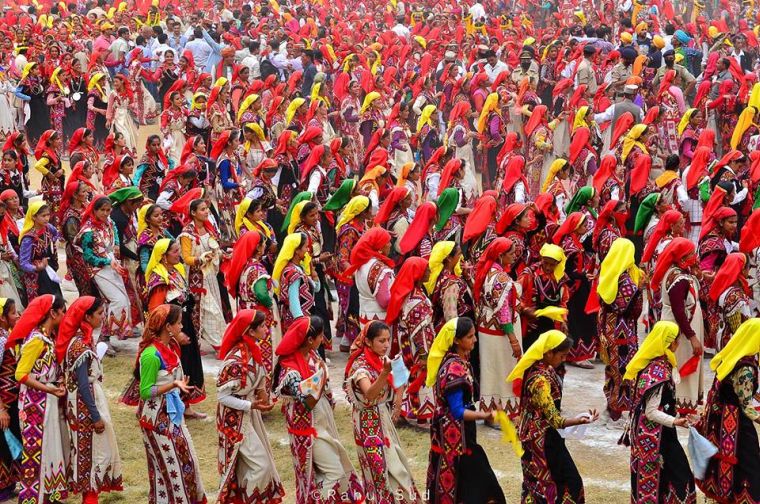
Kullu folk danceOver 9,000 artistes performed a folk dance in Himachal Pradesh to highlight the "Save the Girl Child" message and the event created a world record of largest participation at one point of time, an official said on Tuesday. The performance by 9,892 folk dancers during the Kullu Dussehra celebrations on October 26 2015 in Kullu town has entered the pages of the Guinness World Records, Kullu deputy commissioner Rakesh Kanwar, the brain behind the event, told to newspersons on 11th January 2016.

"The folk dancers assembled at one venue, braving rain and cold, to create the new world record. About 8,500 dancers had participated in the mass folk dance event last year and this year the number of dancers has increased significantly and we have qualified inclusion in Guinness book of world records," the Deputy Commissioner said.

He said a communication in this regard was received from the Guinness World Records authorities on 11th January 2016. Kanwar said the Kullu Natti - as the folk dance is called - was the largest voluntary dance in the world. Dressed in traditional Himachali attire, the dancers performed on October 26 last year. Kanwar said the participants, this time both men and women, also took a pledge to work for the cause of the girl child. He said there was no prior category or world record related to the folk dance. The Guinness World Records office in London monitored the performance. Earlier in 2014, a total of 8,540 artists performed a folk dance also during the Kullu Dussehra festivities and entered the Limca Book of Records. Chief Minister Virbhadra Singh lauded the efforts of the Kullu administration for conducting the mega cultural event. The chief minister said he himself witnessed the event organised under the aegis of 'Beti Hai Anmol' which effectively spread the mass awareness on saving the girl child. Himachal Pradesh has now been bracketed among the 10 states having the worst sex ratio in the country at 909 females to 1,000 males. The overall national sex ratio according to the 2011 Census is 940 females per 1,000 males.

The event lasted for about 90 minutes and folk dancers of various regions of Kullu valley performed. About 14,700 dancers had got their names registered for the event but due to bad weather many of them could not reach the venue.

The troupes of folk dancers had started arriving at Dhalpur Maidan from 7.30 AM and the sprawling ground turned colourful by 11.00 AM when the danced actually started and people enjoyed it for nearly 90 minutes.

Wednesday, January 6, 2016

WORLD'S HIGHEST RUNS SCORED IN CRICKET

An Indian schoolboy has smashed one of cricket’s oldest records, with the highest run total ever seen in an organised game.

Pranav Dhanawade, a 15-year-old student of KC Gandhi School, became the first ever batsman to reach 1000 runs, hitting the whopping total in just 323 balls. Dhanawade had reached the unbelievable score of 1009 not out in the Bhandari Trophy match against Arya Gurukul School in Mumbai on Tuesday.

Even then, the sheer numbers make for mind-boggling reading. Dhanawade, the son of an autorickshaw driver, faced just 323 deliveries. The relatively smaller dimensions of the ground — the straight boundary being the longest at 60 yards — perhaps contributed to the 129 fours and 59 sixes hit by Dhanawade, and the strike rate of 312.38. On two occasions, windows from a nearby building were smashed.

Just after Dhanawade surpassed the milestone late on the second day of the match, his side declared with an immense 1465 first innings total, with the 15-year-old finishing on 1009 not out.

The young cricket sensation’s innings included 59 sixes and 129 fours. The figures of the opposition bowlers made for nightmare reading.

Dhanawade surpassed the previous world record for an individual score midway through his innings, hammering past English schoolboy Arthur Collins’ 1899 record of 628. The 15-year-old had already reached the all-time record at the close of the first day, having hit 82 fours and 42 sixes to give himself a total of 652 not out.

Tuesday, January 5, 2016

WORLD'S CHEAPEST CAR

Indian carmaker Tata Motors gave the world its cheapest car in the form of Nano. The Tata Nano is a city car manufactured and sold in India, the Nano was initially launched with a price tag of Rs 100,000 = U$2500 which was ultimately increased with time. Designed to lure India's burgeoning middle classes away from two-wheelers, it received much publicity.

This is a benchmark in engineering and has very basic features. The car gives excellent fuel economy and has a very efficient engine. The car offers a rear-wheel drive with its two cylinders 623 cc engine offering 33ps power. The engine is a multi-fuel injection petrol type. It is the first time the car is using a two-cylinder gasoline engine along with a balance shaft added to it.

Tata Nano has features such as crumple zones, intrusion-resistant doors, seat belts, strong seats, anchorages, rear tailgate glass attached to the body of the car and tubeless tyres.

Currently the car is priced between Rs 1,15,361 - Rs 1,72,361 (ex-showroom, New Delhi).

There was much controversy related to its initial plan of manufacturing the car from Singur, a rural area of West Bengal. Tata Motors announced in 2006 that the Nano would be manufactured in Singur, West Bengal. Local farmers, along with a political party soon began protesting the forced acquisition of their land the new factory entailed. Tata first delayed the Nano launch and later decided to build the car in a different state, Gujarat, instead.

Monday, January 4, 2016

WORLD'S LONGEST CAR JOURNEY

Tata Motors' small car Nano entered the Guinness World Records in 2013 for driving on a longest journey covering the entire country, the company said on Monday.

"The expedition was accomplished in 10 days (March 21st to 30th of 2013) covering 10,218 km in a Tata Nano from Kanyakumari in southern Tamil Nadu to circumnavigate the country and return to Bangalore," Tata Motors president  for Passenger Vehicle Business Unit, Ranjit Yadav said at an event held in Bangalore.

The car entered the Guinness World Records, breaking the previous record of 8,046 km. The official title for the record is "Longest journey by car in a single country".

The car was driven by Bangalore based motoring enthusiast Srikarunya Subrahmanyam and his team.
"Tata Nano has put India on the world motoring map by demonstrating its robustness, reliability and frugal engineering. We will encourage motor expeditions to enable customers experience the brand's value," Yadav said.

India's first Formula One motor racing driver Narain Karthikeyan felicitated Subrahmanyam and the team for the record achievement on the occasion.
"I have seen a new breed of traveller emerge, one who has a streak of adventure and passion for motoring. I have known people who have driven long distances for the fun of it despite the option of taking a flight or a train being always there. This is the spirit that encourages enthusiasts like Srikarunya to overcome challenges of driving long distances," Karthikeyan said.

Wednesday, July 24, 2013

WORLD'S HIGHEST SCORING ODI PARTERNERSHIP

The highest-scoring batting partnership in a one-day international is 331, by Sachin Tendulkar ( 186 not out ) and Rahul Dravid ( 153 ) for India v New Zealand at Lal Bahadur Shastri Stadium, Hyderabad, India, on 8 November 1999. They scored in the second wicket. The one day international match was against New Zealand, in the season of 1999.


The second highest batting partnership in a one-day international (318 runs) is also held by Rahul Dravid along with Saurav Ganguly.

Monday, July 8, 2013

WORLD'S MOST FORWARD THINKING RAIL TRAVELLER

Fakhruddin Takulla STARTING HIS JOURNEY

An Indian man has entered the record books after making a rail journey to Delhi on a 26-year-old ticket.

On 19th Jan 2000 Fakhruddin Takulla ( India ) travelled from Mumbai ( Bombay ) to New Delhi, both India, using a ticket he had purchased on 15 July 1973 – 26 years 6 months earlier. Takulla used the unlimited booking service offered by the Indian Railway Authority so that he could attend the celebrations marking the 50th anniversary of Indian Independence.

Shri Fakhruddin Takulla, resident of Bombay, shocked the reservation clerk on duty at Western Railway's reservation office some time in 1973 when he approached him to book an AC Chair Car ticket to travel from Bombay Central to New Delhi by the Rajdhani Express 27 years later in January, 2000! Such bookings were then allowed under Railway Board's experimental scheme to permit would-be passengers to book their reservations in all trains without any time cap. Initially the clerk was reluctant for he had no calendar for 2000 to know whether the train would run on the specified date 27 years later for the Rajdhani then (in 1973) used to run only thrice a week. Further it was also too much of an 'unnecessary' hassle for the clerk to keep records, etc., safely for the next millennium. But the enterprising Shri Takulla would not give up as he produced a manual calendar, which he had drawn up himself, to let the clerk know the exact day and date of date of his journey! Finally, thus, he got his precious ticket for Rs 120/-.

Later Shri Takulla indeed took the journey to New Delhi by the Rajdhani Express to arrive there well in time to see the Golden Jubilee Republic Day celebrations in January 2000. He was grateful to Allah for keeping him alive to see the destined day 27 years later.

Indian Railways played the good Samaritan for they exchanged his ticket gratis for AC 3-tier class as by 2000 the AC Chair Car class had vanished from the Rajdhani. They also gave him a VIP treatment by deputing a railway official to receive him at New Delhi station on arrival and arranged for his lodging in New Delhi at a railway guesthouse for 8 days, and also arranged for his return journey at no cost to him. Shri Takulla was also given a place in the VIP gallery to watch the Republic Day celebrations. 'We felt that a person who could think of doing this 27 years ago obviously had tremendous faith in the reliability of the Indian railway network and we felt that we needed to acknowledge that and respond to it adequately,' said Shri Shanti Narain, member of the Railway Board.

At 61, Fakruddin Takulla now wants to book a ticket for 2038 - when he will be 100.His dream now is to go to his ancestral home in Kaparwaj, in the western state of Gujarat.

Saturday, July 6, 2013

WORLD'S LARGEST RIVERINE ISLAND


Majuli is the largest riverine island in the world and is located within the Brahmaputra River, in the Indian state of Assam.

All of the above the river, its tributaries, the wet lands and the chaporis along with the island of Majuli make it the largest mid river delta system in the world. It is a pollution free fresh water island. Total area of the island was 1250 sq.km., now it is about 577 sq.km., having lost significant area due to erosion by the river Brahmaputra. Its length from east to west is about 90 km. & width from north to south is avg. 16 km. Majuli is a natural & cultural heritage site. With water bodies covering most of the areas , Majuli attracts plenty of birds both local & migratory. The island was formed due to course changes by the river Brahmaputra and its tributaries, mainly the Lohit.

The island is about 200 kilometres east from the state’s largest city — Guwahati, and is accessible by ferries from the town of Jorhat. It is located 20 km. off Jorhat town. Majuli is a civil sub-division of Jorhat District.

Majoli is also the abode of the Assamese neo-Vaisnavite culture. About 25—26 Satras are remaining now in Majuli of which the Satras of Kamalabari, Auniati & Garmur are worth mentioning. These Satras are propagating the religious ideology of great Assamese medieval Vaisnavite Saint Sankardeva & Madhavdeva, preaching Satria culture.

A wetland, Mājuli is a hotspot for flora and fauna, harbouring many rare and endangered avifauna species including migratory birds that arrive in the winter season. Among the birds seen here are: the Greater Adjutant Stork, Pelican, Siberian Crane and the Whistling Teal. After dark wild geese and ducks fly in flocks to distant destinations. The island is almost pollution free owing to the lack of polluting industries and factories and also the chronic rainfall.

The dwellers of Mājuli are mostly tribal folk. These tribal are the Mising tribes from Arunachal Pradesh and who immigrated here centuries ago. Apart from them, the inhabitants are also from the Deori and Sonowal Kacharis tribes. Languages spoken here are Mising, Assamese, Deori. The island has one hundred and forty four villages with a population of over 150,000 and a density of 300 individuals per square km. The only mode of association to the outside world is through a ferry service which operates only twice a day. Despite inherent drawbacks faced, modernism has touched this island, with the setting up of medical centers and educational institutions. Housing too, has segued from traditional bamboo and mud construction to ones
made of concrete.

The heart of all villages is the Namghar, where villagers episodically gather to sing and pray. It is the most important public place for the villagers. After the rituals are complete, villagers decide here on issues concerning the village such as auctioning of fishing rights, what to do with money raised, and other topics of significance to the community as a whole.

The inhabitants are expert navigators by boat; their expertise is most visible during the monsoon season when they navigate the turbulent waters of the Brahmaputra.


Thursday, July 4, 2013

WORLD'S LARGEST CAT


The tiger (Panthera tigris) is the largest cat species, reaching a total body length of up to 3.3 m (11 ft) and weighing up to 306 kg (670 lb). It is the third largest land carnivore (behind only the polar bear and the brown bear).

There are 9 subspecies of tiger, three of which are extinct. The Bengal tiger (P. t. tigris), The Indochinese tiger (P. t. corbetti), The Malayan tiger (P. t. jacksoni), The Sumatran tiger (P. t. sumatrae), The Siberian tiger (P. t. altaica), The South China tiger (P. t. amoyensis)

Extinct subspecies: The Bali tiger (P. t. balica), The Caspian tiger (P. t. virgata), The Javan tiger (P. t. sondaica)

The Bengal tiger (P. t. tigris), also called the Indian tiger or the Royal Bengal Tiger, lives in India, Nepal, Bhutan, and Bangladesh, and is the most common subspecies, with populations estimated at less than 2,500 adult individuals. In 2011, the total population of adult tigers was estimated at 1,520–1,909 in India, 440 in Bangladesh, 155 in Nepal and 75 in Bhutan. It lives in alluvial grasslands, subtropical and tropical rainforests, scrub forests, wet and dry deciduous forests, and mangroves. Male Bengal tigers have a total length, including the tail, of 270 to 310 cm (110 to 120 in), while females range from 240 to 265 cm (94 to 104 in). The weight of males range from 180 to 260 kg (400 to 570 lb), while that of the females range from 100 to 160 kg (220 to 350 lb). In northern India and Nepal, tigers tend to be of larger size. Males often average 235 kilograms (520 lb), while females average 141 kilograms (310 lb). In 1972, Project Tiger was founded in India aiming at ensuring a viable population of tigers in the country and preserving areas of biological importance as a natural heritage for the people. But the illicit demand for bones and body parts from wild tigers for use in traditional Chinese medicine is the reason for the unrelenting poaching pressure on tigers on the Indian subcontinent. Between 1994 and 2009, the Wildlife Protection Society of India has documented 893 cases of tigers killed in India, which is just a fraction of the actual poaching and illegal trade in tiger parts during those years. An area of special conservation interest lies in the Terai Arc Landscape in the Himalayan foothills of northern India and southern Nepal, where 11 protected areas comprising dry forest foothills and tall grass savannas harbor tigers in a landscape of 49,000 square kilometres (19,000 sq mi). The goals are to manage tigers as a single metapopulation, the dispersal of which between core refuges can help maintain genetic, demographic, and ecological integrity, and to ensure that species and habitat conservation becomes mainstreamed into the rural development agenda. In Nepal, a community-based tourism model has been developed with a strong emphasis on sharing benefits with local people and on the regeneration of degraded forests. The approach has been successful in reducing poaching, restoring habitats, and creating a local constituency for conservation.

Tigers range in size from the diminutive Sumatrans—females weigh between 165 and 242 pounds, and males weigh between 220 and 310 pounds—to the largest mainland tigers, such as Indians—females weigh between 220 and 352 pounds, and males weigh between 396 and 670 pounds. Total length ranges from seven to 11 feet.

Habitat:
The tiger's current distribution is a patchwork across Asia, from India to the Russian Far East. Tigers require large areas with forest cover, water, and suitable large ungulate prey such as deer and swine. With these three essentials, tigers can live from the tropical rainforests of Sumatra and Indochina to the temperate oak forest of the Amur River Valley in the Russian Far East.

Diet:
Tigers prey primarily on wild boar (Sus scrofa) and other swine, and medium to large deer such as chital (Axis axis), red deer (Cervus elaphus), and sambar (C. unicolor). Where they occur together, tigers also hunt gaur (Bos frontalis), a huge wild cattle. Tigers also kill domestic animals such as cows and goats, and occasionally kill people.

Hunting:
The tiger hunts alone, primarily between dusk and dawn, traveling six to 20 miles in a night in search of prey. A typical predatory sequence includes a slow, silent stalk until the tiger is 30 to 35 feet from the selected prey animal followed by a lightening fast rush to close the gap. The tiger grabs the animal in its forepaws, brings it to the ground, and finally kills the animal with a bite to the neck or throat. After dragging the carcass to a secluded spot, the tiger eats. A tiger eats 33 to 40 pounds of meat in an average night, and must kill about once per week. Catching a meal is not easy; a tiger is successful only once in ten to 20 hunts.


Sunday, June 30, 2013

WORLD'S LARGEST MILITARISED ZONE


Jammu and Kashmir, once only known for its picturesque beauty, continues to have a mention in the Guinness Book of  World Records as the most militarised zone and the longest pending dispute on the planet earth. The book says that occupied Kashmir has made its place in the facts book for four reasons and all the reasons are linked to the pending dispute.

Ever since the independence of India & Pakistan from the colonial rule of the British, they have locked horns over the occupation of Kashmir. Since the partition of sub continent, Kashmir which was a princely state, became a bone of contention between India and Pakistan. Both the nuclear-armed countries claim the territory but rule it in parts since 1947. India and Pakistan have fought two wars over the territory, and are usually at loggerheads over everything related to Kashmir.
Guinness says up to 1 million troops stare at each other across the Line of Control which separates Indian administered and Pakistani administered parts of Jammu and Kashmir state.

According to the CIA world book, the dispute between China, India and Pakistan over the issue of Kashmir has made it the largest and the most militarized territorial dispute in the world. In 1989, armed insurgency in Kashmir began and India & Pakistan has since deployed an estimated 1 million troops in the region. The Guinness book of records adds that at any one time, up to 1 million troops confront each other across the Line of Control.

Experts say the silence of international community over the sufferings of Kashmiri people has resulted into more repression. Kashmir has made its place in the facts book for four reasons and all the reasons are linked to the pending dispute , the book says, Kashmir is the World’s highest battle field and largest militarized zone . It has also the highest number of military bases in the world and finally the lengthiest speech in the United Nations was given over the dispute of Kashmir. It lasted for 8 hours.


Tuesday, June 25, 2013

MOST PEOPLE SINGING NATIONAL ANTHEM


A private business house in Lucknow, Uttar Pradesh, India, had attempted to create a new world record with over 100,000 of its employees singing the country's national anthem together at one point in one uniform on Monday, 6th May 2013.

As a special and commemorative gift to the Nobel laureate Rabindranath Tagore, as 1,21,653 staff and workers of Sahara India Pariwar recited the National Anthem 'Jana Gana Mana' in unison at a place, eclipsing the current Guinness record of 42,813 persons held by Pakistan. The occasion was to attempt a place in the Guinness World Record. The patriotic fervour did not stop here, as more than one million staff at 4,512 offices of Sahara also sang the National Anthem together.

Chairman of the Sahara Group, Subrata Roy, while addressing the gathering at a stadium in Lucknow, expressed his delight as his company's attempt to create a new world record.Roy says he espouses a philosophy of "collective materialism" and according to Sahara's website, the group shares its profits between staff, its internal fund and social development activities and has never declared a dividend.

Written in Sanskritised Bangla, 'Jana Gana Mana' was first sung at the Calcutta session of the Indian National Congress on December 27, 1911. It was officially adopted by the Constituent Assembly as the National Anthem of India on January 24, 1950.

There were hundreds of onlookers -- men, women and youngsters from various cities of the state - who had congregated at Ramabai Ambedkar Rally Sthal, giving it a look of mini-Kumbh, as they settled down to take their final position for the record breaking attempt. Another interesting aspect of the event was the use of air-borne camera to capture the images of the participants, and helping the third party auditors in the counting and verification process.

When asked what prompted them to undertake this activity, Subrata Roy, managing worker and chairman, Sahara India Pariwar, said, "When I first came to know that Pakistan is holding the current world record, I thought that it should be India, which must have it. And with a dedicated team, we faced no challenges in accomplishing this goal."

Before the start of the event, Subrata Roy motivated the participants. During the event, the participants paid tributes to the martyrs, who laid down their lives for the country, by observing a two-minute silence. The male workers of Sahara were wearing a uniform of white shirt, black pants and black ties, while the women sported red saris (traditional wear).

Speaking to reporters before the event started, adjudicator Pravin Patel of Guinness World Records said, "For every 50 members of the crowd, a third-party auditor is on the job to come out with the accurate number of participants." After the record was officially confirmed, Patel said that it is one of the most disciplined performances he has seen so far.


Saturday, June 22, 2013

MOST SONG RECORDINGS IN A DAY


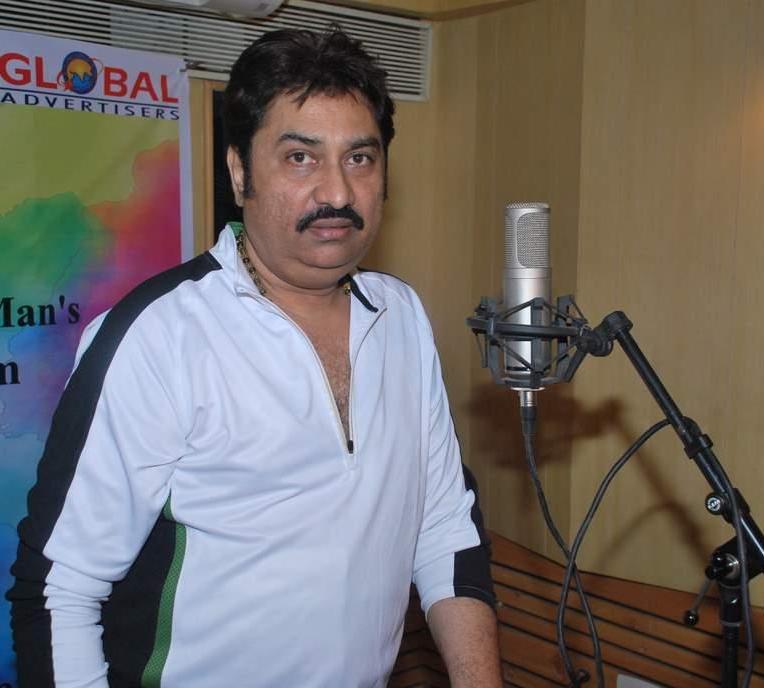
Kumar Sanu is one of the most popular playback singers of Bollywood. He holds the Guinness Book world record since 1993 for recording the maximum number of songs in a day, which are 28. He was born on 23rd September, 1957 in Kolkata and was named Kedernath Bhattacharjee. His father, Pashupati Bhattacharjee was a renowned classical singer and composer who noticed his son's talent at a very young age. When he was still very young, his father trained him to sing classical music and play the tabla. Given here is a small list of achievements which captures the life history of Kumar Sanu. 

 
Awards won:
He is a recipient of the Padma Shri award in 2009, India's 4th highest civilian honour given by Government of India. He won the Filmfare Best Male Playback Award for 5 consecutive years.

Filmfare Best Male Playback Award

    1990; Ab tere bin jeelenge hum - Aashiqui
    1991: Mera Dil Bhi Kitna Pagal Hai - Saajan
    1992: Sochenge Tumhe Pyaar - Deewana
    1993: Yeh Kaali Kaali Aankhen - Baazigar
    1994: Ek Ladki Ko Dekha - 1942: A Love Story

    1994: Ek Ladki Ko Dekha - 1942: A Love Story - Star Screen Award
    2000: Ankhoon ki gustakiyan - Hum Dil De Chuke Sanam - IIFA


AddThis