India! The country with amazing diversity and wonders has many champions. All these are real facts and real records. Most of them are certified by authentic record books like Guiness Book of Records & Limca Book of Records. I am trying to tabulate as many as I can. Please help me in my efforts by adding more facts and records.
Showing posts with label Largest. Show all posts

Saturday, January 23, 2016

WORLD'S LARGEST FREE KITCHEN

Langar Hall of Golden Templ
Langar Hall of Golden Temple
Night View of Golden Temple

In Amritsar, India, the Sikh gather in a Golden Temple to serve an average of 100,000 meals every single day of the year in a kitchen that never closes. Not a single one of them will pay for the food they consume. Anyone can eat for free here, and many, many people do. On a weekday, about 80,000 come. On weekends, almost twice as many people visit. Each visitor gets a wholesome vegetarian meal, served by volunteers who embody India’s religious and ethnic mosaic.

The langar, or community kitchen, found in this temple is the largest free kitchen on the planet, serving literally tons of food from a sprawling complex of white marble and gold. With its crowds swelling to some 150,000 on holy days, this Sikh temple sees more daily traffic than the  India’s most popular tourist attraction, the Taj Mahal.

A meal of this scale is made possible by a cadre of volunteers and an astonishing amount of raw materials: 12,000 kilos of flour,  1,500 kilos of rice, 13,000 kilos of lentils, and up to 2,000 kilos of vegetables. While much of the work is done by hand, a mechanized oven and conveyor belt turn out 200,000 rotis on a daily basis. The langar, as it’s called, never closes—and even late at night, pilgrims will stop by for a meal.
Volunteers working in the Kitchen
The institution of the langar, or free kitchen, is believed to have been started by the first Sikh Guru, Guru Nanak Ji in about 1481 but it was already popular in Chisti Sufis of the Indian subcontinent and it is said to have been started by Baba Farid. It was designed to uphold the principle of equality between all people regardless of religion, caste, colour, creed, age, gender or social status, a revolutionary concept in the caste-ordered society of 16th-century India where Sikhism began. In addition to the ideals of equality, the tradition of langar expresses the ethics of sharing, community, inclusiveness and oneness of all humankind.

Sunday, January 17, 2016

LARGEST RUBY

The largest Ruby weighs 21,955 g (48 lbs 6.43 oz) and measures 310 x 165 x 140 mm (12.20 x 6.49 x 5.51 in) owned by Rajiv Golcha (India) officially measured in Bangalore, India, on 3 June 2009. The ruby has been named "The King Ruby" and is held in the Prestige Gems & Jewels showroom in Bangalore, India. Guinness book has officially accredited it as the largest ruby in the world.

Thursday, January 14, 2016

LARGEST YOGA LESSON

International Yoga DayYoga is a 5,000-year-old physical, mental and spiritual practice Having its origin in India, Which Aims to transform both body and mind. On December 11 in 2014, the United Nations General Assembly declared June 21st as the International Day of Yoga. The declaration came after the call for the adoption of June 21st as International Day of Yoga by Hon’ble Indian Prime Minister, Mr. Narendra Modi during his address to UN General Assembly on September 27, 2014

The largest yoga lesson involved 35,985 participants at an event organised by the Ministry of AYUSH, Government of India on the occasion of the first International Day of Yoga, on Rajpath, New Delhi, India, on 21 June 2015.

The event was organised on a 1.4 km segment of the iconic Rajpath in the centre of New Delhi and 32 LED screens were streaming the live images of four instructors on the main stage. The event was opened with a speech by Prime Minister Narendra Modi, who later participated practising yoga for the duration of the lesson. The event included (roughly) 5,000 school children, 5,000 national cadet corps, 5,000 central army forces, 1,200 women police officers, 5,000 union ministers and similar, 5,000 diplomats and foreign nationals, 15,000 from yoga institutions. To ensure that all participants perform Yoga to the best of their abilities, the Monistry shared a video of exercises to participants 2 months before the event to practice. Earnst and Young validated the count using a barcoded ticketing system and a hierarchy of supervisors, zone capitains and 953 stewards scattered across the entire site.

In the words of Ban Ki-moon, United Nations Secretary-General, "By proclaiming 21 June as the International Day of Yoga, the General Assembly has recognized the holistic benefits of this timeless practice and its inherent compatibility with the principles and values of the United Nations."

Tuesday, January 12, 2016

LARGEST PARTICIPATION IN FOLK DANCE

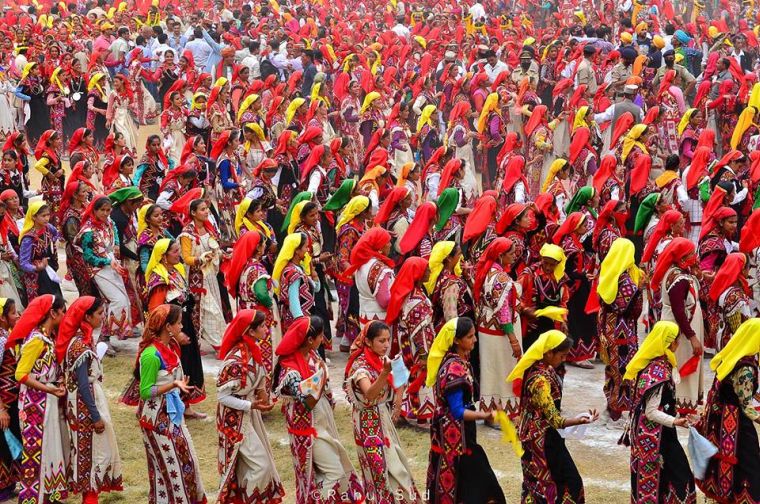
Kullu folk danceOver 9,000 artistes performed a folk dance in Himachal Pradesh to highlight the "Save the Girl Child" message and the event created a world record of largest participation at one point of time, an official said on Tuesday. The performance by 9,892 folk dancers during the Kullu Dussehra celebrations on October 26 2015 in Kullu town has entered the pages of the Guinness World Records, Kullu deputy commissioner Rakesh Kanwar, the brain behind the event, told to newspersons on 11th January 2016.

"The folk dancers assembled at one venue, braving rain and cold, to create the new world record. About 8,500 dancers had participated in the mass folk dance event last year and this year the number of dancers has increased significantly and we have qualified inclusion in Guinness book of world records," the Deputy Commissioner said.

He said a communication in this regard was received from the Guinness World Records authorities on 11th January 2016. Kanwar said the Kullu Natti - as the folk dance is called - was the largest voluntary dance in the world. Dressed in traditional Himachali attire, the dancers performed on October 26 last year. Kanwar said the participants, this time both men and women, also took a pledge to work for the cause of the girl child. He said there was no prior category or world record related to the folk dance. The Guinness World Records office in London monitored the performance. Earlier in 2014, a total of 8,540 artists performed a folk dance also during the Kullu Dussehra festivities and entered the Limca Book of Records. Chief Minister Virbhadra Singh lauded the efforts of the Kullu administration for conducting the mega cultural event. The chief minister said he himself witnessed the event organised under the aegis of 'Beti Hai Anmol' which effectively spread the mass awareness on saving the girl child. Himachal Pradesh has now been bracketed among the 10 states having the worst sex ratio in the country at 909 females to 1,000 males. The overall national sex ratio according to the 2011 Census is 940 females per 1,000 males.

The event lasted for about 90 minutes and folk dancers of various regions of Kullu valley performed. About 14,700 dancers had got their names registered for the event but due to bad weather many of them could not reach the venue.

The troupes of folk dancers had started arriving at Dhalpur Maidan from 7.30 AM and the sprawling ground turned colourful by 11.00 AM when the danced actually started and people enjoyed it for nearly 90 minutes.

Saturday, July 6, 2013

WORLD'S LARGEST RIVERINE ISLAND


Majuli is the largest riverine island in the world and is located within the Brahmaputra River, in the Indian state of Assam.

All of the above the river, its tributaries, the wet lands and the chaporis along with the island of Majuli make it the largest mid river delta system in the world. It is a pollution free fresh water island. Total area of the island was 1250 sq.km., now it is about 577 sq.km., having lost significant area due to erosion by the river Brahmaputra. Its length from east to west is about 90 km. & width from north to south is avg. 16 km. Majuli is a natural & cultural heritage site. With water bodies covering most of the areas , Majuli attracts plenty of birds both local & migratory. The island was formed due to course changes by the river Brahmaputra and its tributaries, mainly the Lohit.

The island is about 200 kilometres east from the state’s largest city — Guwahati, and is accessible by ferries from the town of Jorhat. It is located 20 km. off Jorhat town. Majuli is a civil sub-division of Jorhat District.

Majoli is also the abode of the Assamese neo-Vaisnavite culture. About 25—26 Satras are remaining now in Majuli of which the Satras of Kamalabari, Auniati & Garmur are worth mentioning. These Satras are propagating the religious ideology of great Assamese medieval Vaisnavite Saint Sankardeva & Madhavdeva, preaching Satria culture.

A wetland, Mājuli is a hotspot for flora and fauna, harbouring many rare and endangered avifauna species including migratory birds that arrive in the winter season. Among the birds seen here are: the Greater Adjutant Stork, Pelican, Siberian Crane and the Whistling Teal. After dark wild geese and ducks fly in flocks to distant destinations. The island is almost pollution free owing to the lack of polluting industries and factories and also the chronic rainfall.

The dwellers of Mājuli are mostly tribal folk. These tribal are the Mising tribes from Arunachal Pradesh and who immigrated here centuries ago. Apart from them, the inhabitants are also from the Deori and Sonowal Kacharis tribes. Languages spoken here are Mising, Assamese, Deori. The island has one hundred and forty four villages with a population of over 150,000 and a density of 300 individuals per square km. The only mode of association to the outside world is through a ferry service which operates only twice a day. Despite inherent drawbacks faced, modernism has touched this island, with the setting up of medical centers and educational institutions. Housing too, has segued from traditional bamboo and mud construction to ones
made of concrete.

The heart of all villages is the Namghar, where villagers episodically gather to sing and pray. It is the most important public place for the villagers. After the rituals are complete, villagers decide here on issues concerning the village such as auctioning of fishing rights, what to do with money raised, and other topics of significance to the community as a whole.

The inhabitants are expert navigators by boat; their expertise is most visible during the monsoon season when they navigate the turbulent waters of the Brahmaputra.


Thursday, July 4, 2013

WORLD'S LARGEST CAT


The tiger (Panthera tigris) is the largest cat species, reaching a total body length of up to 3.3 m (11 ft) and weighing up to 306 kg (670 lb). It is the third largest land carnivore (behind only the polar bear and the brown bear).

There are 9 subspecies of tiger, three of which are extinct. The Bengal tiger (P. t. tigris), The Indochinese tiger (P. t. corbetti), The Malayan tiger (P. t. jacksoni), The Sumatran tiger (P. t. sumatrae), The Siberian tiger (P. t. altaica), The South China tiger (P. t. amoyensis)

Extinct subspecies: The Bali tiger (P. t. balica), The Caspian tiger (P. t. virgata), The Javan tiger (P. t. sondaica)

The Bengal tiger (P. t. tigris), also called the Indian tiger or the Royal Bengal Tiger, lives in India, Nepal, Bhutan, and Bangladesh, and is the most common subspecies, with populations estimated at less than 2,500 adult individuals. In 2011, the total population of adult tigers was estimated at 1,520–1,909 in India, 440 in Bangladesh, 155 in Nepal and 75 in Bhutan. It lives in alluvial grasslands, subtropical and tropical rainforests, scrub forests, wet and dry deciduous forests, and mangroves. Male Bengal tigers have a total length, including the tail, of 270 to 310 cm (110 to 120 in), while females range from 240 to 265 cm (94 to 104 in). The weight of males range from 180 to 260 kg (400 to 570 lb), while that of the females range from 100 to 160 kg (220 to 350 lb). In northern India and Nepal, tigers tend to be of larger size. Males often average 235 kilograms (520 lb), while females average 141 kilograms (310 lb). In 1972, Project Tiger was founded in India aiming at ensuring a viable population of tigers in the country and preserving areas of biological importance as a natural heritage for the people. But the illicit demand for bones and body parts from wild tigers for use in traditional Chinese medicine is the reason for the unrelenting poaching pressure on tigers on the Indian subcontinent. Between 1994 and 2009, the Wildlife Protection Society of India has documented 893 cases of tigers killed in India, which is just a fraction of the actual poaching and illegal trade in tiger parts during those years. An area of special conservation interest lies in the Terai Arc Landscape in the Himalayan foothills of northern India and southern Nepal, where 11 protected areas comprising dry forest foothills and tall grass savannas harbor tigers in a landscape of 49,000 square kilometres (19,000 sq mi). The goals are to manage tigers as a single metapopulation, the dispersal of which between core refuges can help maintain genetic, demographic, and ecological integrity, and to ensure that species and habitat conservation becomes mainstreamed into the rural development agenda. In Nepal, a community-based tourism model has been developed with a strong emphasis on sharing benefits with local people and on the regeneration of degraded forests. The approach has been successful in reducing poaching, restoring habitats, and creating a local constituency for conservation.

Tigers range in size from the diminutive Sumatrans—females weigh between 165 and 242 pounds, and males weigh between 220 and 310 pounds—to the largest mainland tigers, such as Indians—females weigh between 220 and 352 pounds, and males weigh between 396 and 670 pounds. Total length ranges from seven to 11 feet.

Habitat:
The tiger's current distribution is a patchwork across Asia, from India to the Russian Far East. Tigers require large areas with forest cover, water, and suitable large ungulate prey such as deer and swine. With these three essentials, tigers can live from the tropical rainforests of Sumatra and Indochina to the temperate oak forest of the Amur River Valley in the Russian Far East.

Diet:
Tigers prey primarily on wild boar (Sus scrofa) and other swine, and medium to large deer such as chital (Axis axis), red deer (Cervus elaphus), and sambar (C. unicolor). Where they occur together, tigers also hunt gaur (Bos frontalis), a huge wild cattle. Tigers also kill domestic animals such as cows and goats, and occasionally kill people.

Hunting:
The tiger hunts alone, primarily between dusk and dawn, traveling six to 20 miles in a night in search of prey. A typical predatory sequence includes a slow, silent stalk until the tiger is 30 to 35 feet from the selected prey animal followed by a lightening fast rush to close the gap. The tiger grabs the animal in its forepaws, brings it to the ground, and finally kills the animal with a bite to the neck or throat. After dragging the carcass to a secluded spot, the tiger eats. A tiger eats 33 to 40 pounds of meat in an average night, and must kill about once per week. Catching a meal is not easy; a tiger is successful only once in ten to 20 hunts.


Sunday, June 30, 2013

WORLD'S LARGEST MILITARISED ZONE


Jammu and Kashmir, once only known for its picturesque beauty, continues to have a mention in the Guinness Book of  World Records as the most militarised zone and the longest pending dispute on the planet earth. The book says that occupied Kashmir has made its place in the facts book for four reasons and all the reasons are linked to the pending dispute.

Ever since the independence of India & Pakistan from the colonial rule of the British, they have locked horns over the occupation of Kashmir. Since the partition of sub continent, Kashmir which was a princely state, became a bone of contention between India and Pakistan. Both the nuclear-armed countries claim the territory but rule it in parts since 1947. India and Pakistan have fought two wars over the territory, and are usually at loggerheads over everything related to Kashmir.
Guinness says up to 1 million troops stare at each other across the Line of Control which separates Indian administered and Pakistani administered parts of Jammu and Kashmir state.

According to the CIA world book, the dispute between China, India and Pakistan over the issue of Kashmir has made it the largest and the most militarized territorial dispute in the world. In 1989, armed insurgency in Kashmir began and India & Pakistan has since deployed an estimated 1 million troops in the region. The Guinness book of records adds that at any one time, up to 1 million troops confront each other across the Line of Control.

Experts say the silence of international community over the sufferings of Kashmiri people has resulted into more repression. Kashmir has made its place in the facts book for four reasons and all the reasons are linked to the pending dispute , the book says, Kashmir is the World’s highest battle field and largest militarized zone . It has also the highest number of military bases in the world and finally the lengthiest speech in the United Nations was given over the dispute of Kashmir. It lasted for 8 hours.


Thursday, May 23, 2013

WORLD'S LARGEST INDIVIDUAL PLANT

By a strict definition of individuality, and using contending measures of size, , the giant banyan trees of India, Ficus benghalensis, are the largest trees in the world. In these trees, a network of interconnected stems and branches has grown entirely by vegetative, "branching" propagation. One individual, Thimmamma Marrimanu, in Anantapur district of Andhra Pradesh, India,  covers 19,107 square metres (4 acres), making it the largest single tree by two-dimensional canopy coverage area. This tree is also the world's largest known tree by a related measure, perimeter length, with a distance of 846 metres required to walk around the edge of the canopy. Thimmama Marrimanu is likely also the world's largest tree by three dimensional canopy volume. It is present in the Indian Botanical Gardens and is more than 200 years old. Its branches spreads over 8 acres, and hence was recorded as the biggest tree in the Guinness Book of World Records in 1989. A small temple dedicated to Thimmamma lies under the tree. An account of this lady in Telugu kept at the shrine reveals that she was the daughter of a Setti Balija couple Sennakka Venkatappa and Mangamma, born in AD 1394. She was married to a Bala Veerayya who died in 1434, and Thimmamma committed Sati. The banyan tree is believed to have sprouted at the place where she ascended the funeral pyre.


Saturday, May 18, 2013

WORLD'S LARGEST SUNDIAL

The Jantar Mantar, situated at Jaipur, Indua is the world's largest sundial. It is a collection of architectural astronomical instruments, built by Sawai Jai Singh who was a Mughal Commander and served Emperor Aurangzeb and later Mughals. He had constructed a total of five such facilities at different locations, including the ones at Delhi and Jaipur. The Jaipur observatory is the largest and best preserved of these. It has been inscribed on the World Heritage List as "an expression of the astronomical skills and cosmological concepts of the court of a scholarly prince at the end of the Mughal period". Early restoration work was undertaken under the supervision of Major Arthur Garrett, a keen amateur astronomer, during his appointment as Assistant State Engineer for the Jaipur District.

The name is derived from jantar("instrument/machine"), and Mantar ("formula", or in this context "calculation"). Therefore jantar mantar means literally 'calculation instrument'. This observatory has religious significance, since ancient Indian astronomers were also Jyotisa masters.

The observatory consists of fourteen major geometric devices for measuring time, predicting eclipses, tracking stars' location as the earth orbits around the sun, ascertaining the declinations of planets, and determining the celestial altitudes and related ephemerides. Each is a fixed and 'focused' tool. The Samrat Yantra, the largest instrument, is 90 feet (27 m) high, its shadow carefully plotted to tell the time of day. Its face is angled at 27 degrees, the latitude of Jaipur. The Hindu chhatri (small cupola) on top is used as a platform for announcing eclipses and the arrival of monsoons.

Built from local stone and marble, each instrument carries an astronomical scale, generally marked on the marble inner lining. Bronze tablets, all extraordinarily accurate, were also employed. Thoroughly restored in 1901, the Jantar Mantar was declared a national monument in 1948.

The instruments are in most cases huge structures. The scale to which they have been built has been alleged to increase their accuracy. However, the penumbra of the sun can be as wide as 30 mm, making the 1mm increments of the Samrat Yantra sundial devoid of any practical significance. Additionally, the masons constructing the instruments had insufficient experience with construction of this scale, and subsidence of the foundations has subsequently misaligned them. The samrat yantra, for instance, which is a sundial, can be used to tell the time to an accuracy of about two seconds in Jaipur local time.[3] The Giant Sundial, known as the Samrat Yantra (The Supreme Instrument) is the world's largest sundial, standing 27 meters tall. Its shadow moves visibly at 1 mm per second, or roughly a hand's breadth (6 cm) every minute, which can be a profound experience.

Today the observatory is a popular tourist attraction. However, local astronomers still use it to predict the weather for farmers, although their authority is becoming increasingly questionable. Students of astronomy and Vedic astrology are required to take some of their lessons at the observatory, and it can be said that the observatory is the single most representative work of Vedic thought that still survives, apart from the texts. Many of the smaller instruments display remarkable innovation in architectural design and its relation to function, for instance - the Ram Yantra.

Sunday, April 28, 2013

WORLD'S LARGEST HUMAN GATHERING

An estimated 30 million people visited the Maha Kumbh Mela on 10 February 2013 and an estimated 100 million are expected to visit the place during the festival spread over 55 days. Both (in a single day and over a specific period) are the largest peaceful human assemblies in the world. According to estimates, around 70 million people participated in the 45-day Ardh Kumbh Mela at Prayag in 2007. The Purna Kumbh Mela held in 2001 in Prayag was estimated to have attracted between 30 and 70 million people.

The Maha Kumbh Mela, or Grand Pitcher Festival, takes place every 12 years in Northern India and sees millions of devotees bathe in the Ganges to purify their sins. The Kumbh is held at the confluence of the Ganges and Yamuna rivers, where Hindu scriptures say the gods spilt a drop of the elixir of immortality.

Kumbh Mela takes place every twelve years at one of four places: Allahabad, Haridwar, Ujjain and Nashik. The Mela in its different forms alternates between Prayag, Nashik, Ujjain and Haridwar every third year. The Ardh (half) Kumbh Mela is celebrated every six years at only two places, Haridwar and Prayag.

    Kumbha Mela: Held at all four places.
    Ardha Kumbha Mela: Held at Haridwar and Prayag, every 6 years.
    Purna Kumbha Mela: Held only at Prayag every 12 years.
    Maha Kumbha Mela: Held only at Prayag, every 144 years.

Saturday, October 31, 2009

WORLD'S LARGEST CANNON


The Jaivana cannon is the world's biggest wheeled cannon ever made. It is located at the Jaigarh Fort, Jaipur. It was cast in 1720, during the reign of Maharaja Sawai Jai Singh II of Jaipur. Jaivan rests on a high 4 wheeled carriage. The front wheels are 2.74 m in diameter and the rear wheels are 1.37 m in diameter. The barrel is 6.147 m (20 feet 2 inches) long and weighs 50 tons. It rests on a 7.3 m long shaft. The tip of the barrel is 711 mm in dia., while the rear of the barrel is 906 mm dia. An 776 mm long elevating screw was used for raising and lowering the barrel. The barrel has floral design. An elephant rests on the tip of the barrel and a pair of peacocks are carved in the centre. A pair of ducks also decorates the rear of the barrel. Reportedly, it took four elephants to swivel it around on its axis. About 100 kg. (a quintal) of gun powder fired a shot ball weighing 50 kg.

Never used in battle, the Maharaja Jai Singh reportedly test-fired it once in 1720. The cannon ball is said to have landed at Chaksu about 40 km to the south. The impact formed a pond at the spot. Cannons always had a water tank beside them, for the gunner to jump into to avoid the massive shock wave. Jaivan's gunner is said to have died on the spot on firing the cannon, before he could jump into water. Eight people and one elephant were also reportedly killed by the shock wave and many houses collapsed in Jaipur.The two thick rings on the barrel were used for lifting it with the help of a crane which, though incomplete, is still lying in Jaigarh.

Jaigarh Fort was a center of artillery production for the Rajputs. The foundries provide fascinating information for the visitors. The manner in which they drew in blasts of air from the desert is most intriguing. The formidable strength of Jaivan's builder, the scientifically inclined warrior Sawai Jai Singh II, lay in the large number of artillery and copious supply of munitions which he maintained.

Thursday, September 17, 2009

WORLD'S LARGEST MILK PRODUCING COUNTRY


India is the world's largest milk producer with an annual output of over 100 million tons.
India, being the country with the largest vegetarian population, milk has a special role to play for its many nutritional advantages as well as providing supplementary income to some 70 million farmers in over 500,000 remote villages. Milk also finds its place in many relegious activities. Here milk remains as the number one commodity product by India pushing wheat and rice behind. Country’s output now covers 100 million tonnes and is valued at nearly two lakh crore rupees.

Operation Flood
Operation Flood in India, a project of the National Dairy Development Board (NDDB) was the world's biggest dairy development programme which made India, a milk-deficient nation, the largest milk producer in the world, surpassing the USA in 1998, with about 17 percent of global output in 2010–11, which in 30 years doubled the milk available per person, and which made dairy farming India’s largest self-sustainable rural employment generator.

The annual rate of growth in milk production in India is above 4 per cent, against the world's 1 per cent. This surge of growth can be accredited to the establishment of dairy cooperatives under the Operation Flood program. Growing in this astounding rate, India overtook the U.S. In 1998 as the world's largest milk producer. In United States, where the milk production is anticipated to grow only marginally at 71 million tonnes, occupied the top slot till 1997. In the year 1997, India's milk production was on par with the U.S. at 71 million tonnes. The world milk production in 1998 at 557 million tonnes would continue the steady progress in recent years.

However, the growth rate of both production and consumption is same at around four per cent level. According to dairy expert R S Khanna, the milk consumption is expected to grow at seven per cent by 2020. If there is little change in these rates, the domestic demand of milk may surpass the production.

In spite of being the world’s largest milk producer, India’s milk processing industry is not very large. Only 12% of milk is delivered to dairies as against the world average of 70%.

Sunday, June 14, 2009

WORLD'S LARGEST SOLAR KITCHEN


India is well-known for delicious food, and the kitchen is considered to be a sacred place in any Indian home. And now India has something else to be proud of: the world’s largest solar kitchen. The system has been installed as a collaboration between the Academy for a Better World and Brahma Kumaris World Spiritual University, with technology from Solare-Brücke, Germany. With 84 receivers and cooking at 650 degrees, the system can produce up to 38,500 meals a day when the sun is at its peak!

The solar kitchen has been set up at Taleti, near Mount Abu, situated at a height of 1219 m above sea level in Rajasthan. It boasts of a six-module solar steam cooking system and a total of 84 parabolic dish concentrators shell type receivers. Each oval parabolic concentrator has a reflective surface area of 9.2 square meters, and reflect sunlight on the receivers by special white glass pieces. Steam is collected in the header pipes, which is then directed via insulated pipes to cooking vessels in the kitchen.

The system generates temperatures of up to about 650 degrees, and 3500-4000 kg of steam per day. The food is cooked in 200-400 liters capacity cooking pots, producing an average of 20,000 meals a day, and up to 38,500 meals per day during periods of peak solar radiation maximum.

A total of $5 million has been spent on this endeavor. The Academy for a Better World is interested in renewable energy technologies and the program is part of a special demonstration project of Ministry of New and Renewable Energy (MNRE), Government of India.

Sunday, October 26, 2008

MOST DISHES ON DISPLAY


The largest display of different types of dishes was held at Krishnagiri, Tamil Nadu on March 3, 2007. Marking the year 2007 celebrations, Sree Parshwa Padmavathi Seva Trust of India inspired by His Holliness Sri Vasantha Kumar Keval Chand has organised this spectacular event. There were 2007 dishes(in reference to the year), prepared by 500 cooks assisted by 100 others. The preparation started at 7.00 a.m on march 2, 2007 and finished at 6.45 a.m. on the next day. Significantly, all the dishes were vegetarian. All sweets were made in pure ghee and without egg.

The significance of this event is celebrating the Holi festival in India. Holi is the most colourful festival of the Hindus and falls on the Full moon day in the month of March. It is an ancient festival of myriad colours, of gaiety, of friendships and re-unions all over the country. It is celebrated very grandly with colours, offering of sweets and praying for peace, happiness and prosperity.

Thursday, August 14, 2008

WORLD'S LARGEST DEMOCRACY


With over a billion people, the Republic of India is the world's largest democracy. With a population nearly four times that of the United States, India modeled its government on the British parliamentary system, with thoughtful influences from the United States and the rest of the world. Though China is the most populous country in the world, it is not governed by a democratic system. People of India acquire voting rights at the age of 18. India is the 6th largest country in the world in terms of area. It is one of the most ancient and living civilizations (at least 10, 000 years old).

India is run by a parliament made up of two houses. These two houses are called the LOK SABHA, or "House of the People," and the RAJYA SABHA, or "Council of States." Of the two, the Lok Sabha holds more power, but the two houses work together to make the laws of the country. The parliament is located in India's capital, New Delhi.

Unlike Great Britain, another parliamentary democracy, on which the Indian system is primarily based, India does have a president. This president, a person elected to office for five years by members of both houses and important government officials from all over the country, serves mostly as a figurehead. The president's responsibilities include "officially" appointing ministers — even though someone else actually chooses those ministers. Most of the time, the president's job is simply ceremonial.

In a state of emergency, though, the president can take executive action that a large legislative body like the parliament might not be able to do quickly enough. If India faces a military threat, the president can declare a state of emergency and become the single governing authority in the country. Likewise, if an Indian state fails to function effectively, the president can step in and rule the state directly. Most of the time, however, the prime minister holds the most political power in India.

Friday, August 1, 2008

WORLD'S LARGEST TURTLE


The leatherback turtle (Dermochelys coriacea) is the largest of all living turtles. It is the only living species in the genus Dermochelys. As a sea turtle, the leatherback is the largest and heaviest. It can easily be differentiated from other modern sea turtles by its lack of a bony shell (carapace). Instead, the carapace of the leatherback turtle is covered by skin and the turtle's oily flesh. Hence the name "leatherback". Dermochelys coriacea is the only extant member of the family Dermochelyidae.

The front flippers of a leatherback are longer than in the other marine turtles, even when you take the leatherback's size into account. They can reach 270 cm in adult leatherbacks. Leatherback hatchlings look mostly black when you are glancing down on them, and their flippers are margined in white. Rows of white scales give hatchling leatherbacks the white striping that runs down the length of their backs.

The largest leatherback on record was a male stranded on the West Coast of Wales in 1988. He weighed 916 kg.

The leatherback turtle is a species with a cosmopolitan global range. Of all the existing sea turtle species, D. coriacea has the widest distribution, reaching as far north as Alaska and Norway and as far south as the Cape of Good Hope in Africa and the southernmost tip of New Zealand. The leatherback is found in all tropical and subtropical oceans, and its range has been known to extend well into the Arctic Circle. Globally, there are three major, genetically-distinct populations. The Atlantic Dermochelys population is separate from the ones in the Eastern and Western Pacific, which are also distinct from each other. A third possible Pacific subpopulation has been proposed, specifically the leatherback turtles nesting in Malaysia. This subpopulation however, has almost been eradicated. While specific nesting beaches have been identified in the region, leatherback populations in the Indian Ocean remain generally unassessed and unevaluated. Recent estimates of global nesting populations indicate 26,000 to 43,000 nesting females annually, which is a dramatic decline from the 115,000 estimated in 1980. These declining numbers have contributed to conservation efforts to stabilize the leatherback sea turtles and move their species away from the current status of critically endangered.
While there are few researches that have been done on Dermochelys populations in the Indian Ocean, nesting populations are known from Sri Lanka, the Nicobar Islands and the east cost of India. They come in large numbers to lay eggs on the coast of Orissa in India. It is proposed that these turtles form a separate, genetically distinct Indian Ocean subpopulation.

Thursday, July 24, 2008

WORLD'S LARGEST CRAB


The coconut crab (Birgus latro) is the largest terrestrial crab and also the largest land-living arthropod in the world. It is a highly apomorphic hermit crab and is known for its ability to crack coconuts with its strong pincers in order to eat the contents. It is the only species of the genus Birgus. It is also called the robber crab or palm thief, because some coconut crabs are rumored to steal shiny items such as pots and silverware from houses and tents.

Reports about the size of Birgus latro vary, but most references give a weight of up to 4 kg (8.8 lb), a body length of up to 40 cm (16 in), and a leg span of around 20 cm (0.66 ft), with males generally being larger than females. It is believed that this is near the theoretical limit for a terrestrial arthropod. They can reach an age of up to 30–60 years (references vary). In India, they are found in large numbers on the Sentinel island of the Andaman & Nicobar Islands archipelago.

The body of the coconut crab is, like that of all decapods, divided into a front section (cephalothorax), which has 10 legs, and an abdomen. The front-most pair of legs has large claws used to open coconuts, and these claws (chelae) can lift objects up to 29 kg (64 lb) in weight. The next two pairs, as with other hermit crabs, are large, powerful walking legs which allow coconut crabs to climb vertically up trees (often coconut palms) up to 6 m high. The fourth pair of legs is smaller with tweezer-like chelae at the end, allowing young crabs to grip the inside of a shell or coconut husk to carry for protection; adults use this pair for walking and climbing. The last pair of legs is very small and serves only to clean the breathing organs. These legs are usually held inside the carapace, in the cavity containing the breathing organs. There is some difference in colour between the animals found on different islands, ranging from light violet through deep purple to brown.

Although Birgus latro is a derived type of hermit crab, only the juveniles use salvaged snail shells to protect their soft abdomens, and adolescents sometimes use broken coconut shells to protect their abdomens. Unlike other hermit crabs, the adult coconut crabs do not carry shells, but instead harden their abdominal armor by depositing chitin and chalk. They also bend their tails underneath their bodies for protection, as do most true crabs. The hardened abdomen protects the coconut crab and reduces water loss on land, but has to be moulted at periodic intervals. Moulting takes about 30 days, during which the animal's body is soft and vulnerable, and it stays hidden for protection.

Thursday, July 17, 2008

WORLD'S BIGGEST DONATION OF HAIR


Pilgrims to the Tirupathi Temple in Andhra Pradesh, India, which attracts an average of 30,000 visitors per day, donate their hair as a form of sacrifice. They have their hair shaved off and offer it to the deity in the hope that their troubles will disappear along with their hair. This has for long been a tradition at the temple (and has also led to a booming business in hair export for wigs etc.).The 600 barbers employed by the temple shave the pilgrims' heads 24 hours a day and more than $2.2 million (1.4 million pounds) a year is raised through the auction of the hair.

Tonsuring, the act of shaving your head to propitiate God - is a long standing ritual associated with Tirumala. As per the Vaishavite tradition, devotees offer their hair to the Lord which symbolizes effacing of the ego. Tonsuring used to be done at cottages itself in the past where a barber could be summoned, but new addition is a centralized system which has been put in place at Kalyana Katta, a huge building near the temple. Now, all the barbers sit there in along side each other once you enter the complex. The devotees can pay as per their discretion to the barbers after tonsuring.
The historic shrine of Sri Venkateswara is located on a hill at Tirumala, Chittor district. The temple attracts pilgrims from across the world who are known to stand in serpentine queues for long hours to get a glimpse of the chief deity.

Women devotees who come to Tirupati to tonsure their hair - there are around 4,000 out of the 50,000 who visit the temple every day - had been demanding female barbers for a long time. Women devotees felt uncomfortable sitting close to male barbers. The male barbers, around 400 of them, have been appointed by the Tirumala Tirupati Devasthanam (TTD) board, which runs the temple. Some women even complained that male barbers touched them (sometimes in the face) or misbehaved with them while shaving their hair off.

The Tirumala Tirupati Devasthanams (TTD) will soon leverage the power of the Internet to sell hair collected from tonsured devotees. TTD has sought the help of online auctioneer Matex Net Pvt Ltd to sell 80 tonne of hair worth Rs 60 crore, accumulated between May and October this year. After Tirupati, other temple boards including those of Samayapuram and Palani. with a similar tradition of tonsuring, have also shown an interest in using the online platform to sell collected hair, a company official said. According to the TTD website, on an average, at least 50,000 devotees visit the main temple. The hair collected from the tonsuring centre is reportedly separated into five different varieties. Exporters say hair from men is usually used for coat linings and to extract L-Cystein, a protein used as raw material for a range of products including baby food and doughnuts.

Sunday, July 6, 2008

WORLD'S LARGEST FILM STUDIO COMPLEX


The largest integrated film production complex is the Ramoji Film City in Hyderabad which opened in 1996 with 47 sound stages. Spread over an picturesque 2,500 acres and studded with hills, woods, lakes and striking architecture, it provides camera equipment, set construction, properties, costumes, audio post production, digital post-production / SFX and film processing. Guinness World Records certifies Ramoji Film City as the World's Largest Film Studio Complex. Film producer Ramoji Rao, head of the Ramoji Group, opened the facility in 1996.
It is also a popular tourist attraction as there are top class facilities to promote tourism. A Japanese garden, the ETV planet (a multi-purpose editing suit), a pool, artificial waterfalls, breathtakingly accurate airport terminal, hospital set, railway station, churches, mosques and temples, shopping plazas, palace interiors, chateaus, rural complexes, urban dwellings, and a winding highway are some other places for tourists to visit. The Film City even has honeymoon packages for the newly married couples who are on the lookout for a getaway destination. It caters to the corporate world by offering banquet halls.
For shopping enthusiasts, there are nice handicrafts, pottery and other decorative articles for purchase. Magadha, Meena Bazaar, Frontierland or Black Cat Warehouse are a few avenues from where the visitors can carry home souvenirs of their visit.

Website: http://www.ramojifilmcity.com

Saturday, July 5, 2008

WORLD'S LARGEST WEDDING BANQUET


The world's largest ever wedding banquet was hosted and paid for by Jayalalitha Jayaram, a movie star and former chief minister of Tamil Nadu, India. The luncheon was attended by over 150,000 guests at the wedding of her foster son, V.N.Sudhakaran to N.Sathyalakshmi. The banquet was served by the coast in the state capital, Chennai, on 7 Sept 1995.
Jayalalithaa’s detractors draw attention to the wedding of her adopted son as an example of her extravagant show of wealth. Guinness Book of Records certifies the ensuing wedding banquet as the largest ever. TIME magazine, and many other newspapers in India observed that the ceremony was “a vulgar display of wealth”.
The politician, Jayalalitha Jayaram, is a former movie star who succeeded her companion, a still bigger star named M. G. Ramachandran, after he died as Chief Minister of Tamil Nadu State.
She has set new benchmarks for outlandishness in a country that has never lacked color in its politicians, building a personality cult and, her opponents say, a vast personal wealth.
That many in Tamil Nadu disagree was evident from the turnout for the wedding, which drew more than 150,000 people, many of them Jayalalitha supporters who were bused in from villages all across the state, some journeying a dozen or more hours. In a state where the per capita income is less than $400 a year, and 40 per cent of the population is illiterate, some of the poorest of the wedding guests seemed to be the least concerned about its cost.

AddThis