India! The country with amazing diversity and wonders has many champions. All these are real facts and real records. Most of them are certified by authentic record books like Guiness Book of Records & Limca Book of Records. I am trying to tabulate as many as I can. Please help me in my efforts by adding more facts and records.

Friday, January 15, 2016

FASTEST GROWING PLANT

Bamboo plantsBamboos are the fastest-growing plants in the world, due to a unique rhizome-dependent system. Certain species of the 45 genera of bamboo can grow 91 cm (3 ft) within a 24-hour period, at a rate of almost 4 cm (1.5 in) an hour (a growth around 1 mm every 90 seconds, or one inch every 40 minutes).
Bamboo stem
The incredible growth rate of bamboo grows is one reason it is often used to make sustainable, eco-friendly products. Re-planting bamboo is fairly easy thanks to the swift growth rate of the plant. The spreading root structure allows one rootstock to produce several shoots, permitting horizontal growth.

Bamboo species are found in diverse climates, from cold mountains to hot tropical regions. They occur across East Asia, from 50°N latitude in Sakhalin[11] through to Northern Australia, and west to India and the Himalayas. They also occur in sub-Saharan Africa, and in the Americas from the USA mid-Atlantic states[14] south to Argentina and Chile, reaching their southernmost point at 47°S latitude. Continental Europe is not known to have any native species of bamboo.

Thursday, January 14, 2016

LARGEST YOGA LESSON

International Yoga DayYoga is a 5,000-year-old physical, mental and spiritual practice Having its origin in India, Which Aims to transform both body and mind. On December 11 in 2014, the United Nations General Assembly declared June 21st as the International Day of Yoga. The declaration came after the call for the adoption of June 21st as International Day of Yoga by Hon’ble Indian Prime Minister, Mr. Narendra Modi during his address to UN General Assembly on September 27, 2014

The largest yoga lesson involved 35,985 participants at an event organised by the Ministry of AYUSH, Government of India on the occasion of the first International Day of Yoga, on Rajpath, New Delhi, India, on 21 June 2015.

The event was organised on a 1.4 km segment of the iconic Rajpath in the centre of New Delhi and 32 LED screens were streaming the live images of four instructors on the main stage. The event was opened with a speech by Prime Minister Narendra Modi, who later participated practising yoga for the duration of the lesson. The event included (roughly) 5,000 school children, 5,000 national cadet corps, 5,000 central army forces, 1,200 women police officers, 5,000 union ministers and similar, 5,000 diplomats and foreign nationals, 15,000 from yoga institutions. To ensure that all participants perform Yoga to the best of their abilities, the Monistry shared a video of exercises to participants 2 months before the event to practice. Earnst and Young validated the count using a barcoded ticketing system and a hierarchy of supervisors, zone capitains and 953 stewards scattered across the entire site.

In the words of Ban Ki-moon, United Nations Secretary-General, "By proclaiming 21 June as the International Day of Yoga, the General Assembly has recognized the holistic benefits of this timeless practice and its inherent compatibility with the principles and values of the United Nations."

Tuesday, January 12, 2016

LARGEST PARTICIPATION IN FOLK DANCE

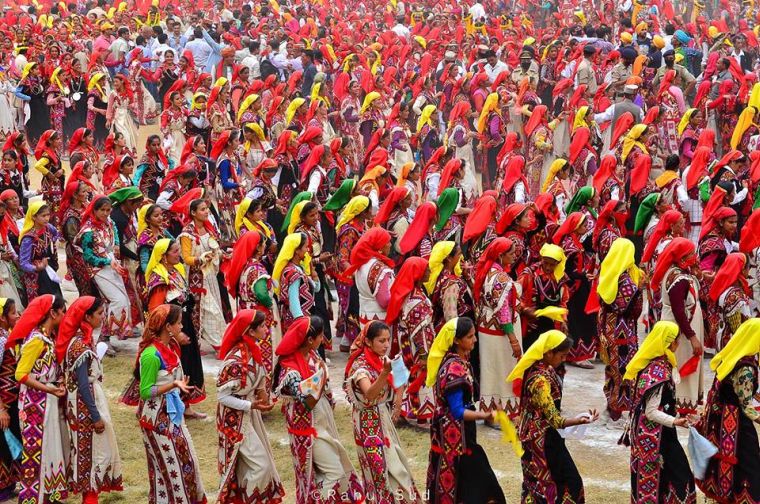
Kullu folk danceOver 9,000 artistes performed a folk dance in Himachal Pradesh to highlight the "Save the Girl Child" message and the event created a world record of largest participation at one point of time, an official said on Tuesday. The performance by 9,892 folk dancers during the Kullu Dussehra celebrations on October 26 2015 in Kullu town has entered the pages of the Guinness World Records, Kullu deputy commissioner Rakesh Kanwar, the brain behind the event, told to newspersons on 11th January 2016.

"The folk dancers assembled at one venue, braving rain and cold, to create the new world record. About 8,500 dancers had participated in the mass folk dance event last year and this year the number of dancers has increased significantly and we have qualified inclusion in Guinness book of world records," the Deputy Commissioner said.

He said a communication in this regard was received from the Guinness World Records authorities on 11th January 2016. Kanwar said the Kullu Natti - as the folk dance is called - was the largest voluntary dance in the world. Dressed in traditional Himachali attire, the dancers performed on October 26 last year. Kanwar said the participants, this time both men and women, also took a pledge to work for the cause of the girl child. He said there was no prior category or world record related to the folk dance. The Guinness World Records office in London monitored the performance. Earlier in 2014, a total of 8,540 artists performed a folk dance also during the Kullu Dussehra festivities and entered the Limca Book of Records. Chief Minister Virbhadra Singh lauded the efforts of the Kullu administration for conducting the mega cultural event. The chief minister said he himself witnessed the event organised under the aegis of 'Beti Hai Anmol' which effectively spread the mass awareness on saving the girl child. Himachal Pradesh has now been bracketed among the 10 states having the worst sex ratio in the country at 909 females to 1,000 males. The overall national sex ratio according to the 2011 Census is 940 females per 1,000 males.

The event lasted for about 90 minutes and folk dancers of various regions of Kullu valley performed. About 14,700 dancers had got their names registered for the event but due to bad weather many of them could not reach the venue.

The troupes of folk dancers had started arriving at Dhalpur Maidan from 7.30 AM and the sprawling ground turned colourful by 11.00 AM when the danced actually started and people enjoyed it for nearly 90 minutes.

Wednesday, January 6, 2016

WORLD'S HIGHEST RUNS SCORED IN CRICKET

An Indian schoolboy has smashed one of cricket’s oldest records, with the highest run total ever seen in an organised game.

Pranav Dhanawade, a 15-year-old student of KC Gandhi School, became the first ever batsman to reach 1000 runs, hitting the whopping total in just 323 balls. Dhanawade had reached the unbelievable score of 1009 not out in the Bhandari Trophy match against Arya Gurukul School in Mumbai on Tuesday.

Even then, the sheer numbers make for mind-boggling reading. Dhanawade, the son of an autorickshaw driver, faced just 323 deliveries. The relatively smaller dimensions of the ground — the straight boundary being the longest at 60 yards — perhaps contributed to the 129 fours and 59 sixes hit by Dhanawade, and the strike rate of 312.38. On two occasions, windows from a nearby building were smashed.

Just after Dhanawade surpassed the milestone late on the second day of the match, his side declared with an immense 1465 first innings total, with the 15-year-old finishing on 1009 not out.

The young cricket sensation’s innings included 59 sixes and 129 fours. The figures of the opposition bowlers made for nightmare reading.

Dhanawade surpassed the previous world record for an individual score midway through his innings, hammering past English schoolboy Arthur Collins’ 1899 record of 628. The 15-year-old had already reached the all-time record at the close of the first day, having hit 82 fours and 42 sixes to give himself a total of 652 not out.

Tuesday, January 5, 2016

WORLD'S CHEAPEST CAR

Indian carmaker Tata Motors gave the world its cheapest car in the form of Nano. The Tata Nano is a city car manufactured and sold in India, the Nano was initially launched with a price tag of Rs 100,000 = U$2500 which was ultimately increased with time. Designed to lure India's burgeoning middle classes away from two-wheelers, it received much publicity.

This is a benchmark in engineering and has very basic features. The car gives excellent fuel economy and has a very efficient engine. The car offers a rear-wheel drive with its two cylinders 623 cc engine offering 33ps power. The engine is a multi-fuel injection petrol type. It is the first time the car is using a two-cylinder gasoline engine along with a balance shaft added to it.

Tata Nano has features such as crumple zones, intrusion-resistant doors, seat belts, strong seats, anchorages, rear tailgate glass attached to the body of the car and tubeless tyres.

Currently the car is priced between Rs 1,15,361 - Rs 1,72,361 (ex-showroom, New Delhi).

There was much controversy related to its initial plan of manufacturing the car from Singur, a rural area of West Bengal. Tata Motors announced in 2006 that the Nano would be manufactured in Singur, West Bengal. Local farmers, along with a political party soon began protesting the forced acquisition of their land the new factory entailed. Tata first delayed the Nano launch and later decided to build the car in a different state, Gujarat, instead.

Monday, January 4, 2016

WORLD'S LONGEST CAR JOURNEY

Tata Motors' small car Nano entered the Guinness World Records in 2013 for driving on a longest journey covering the entire country, the company said on Monday.

"The expedition was accomplished in 10 days (March 21st to 30th of 2013) covering 10,218 km in a Tata Nano from Kanyakumari in southern Tamil Nadu to circumnavigate the country and return to Bangalore," Tata Motors president  for Passenger Vehicle Business Unit, Ranjit Yadav said at an event held in Bangalore.

The car entered the Guinness World Records, breaking the previous record of 8,046 km. The official title for the record is "Longest journey by car in a single country".

The car was driven by Bangalore based motoring enthusiast Srikarunya Subrahmanyam and his team.
"Tata Nano has put India on the world motoring map by demonstrating its robustness, reliability and frugal engineering. We will encourage motor expeditions to enable customers experience the brand's value," Yadav said.

India's first Formula One motor racing driver Narain Karthikeyan felicitated Subrahmanyam and the team for the record achievement on the occasion.
"I have seen a new breed of traveller emerge, one who has a streak of adventure and passion for motoring. I have known people who have driven long distances for the fun of it despite the option of taking a flight or a train being always there. This is the spirit that encourages enthusiasts like Srikarunya to overcome challenges of driving long distances," Karthikeyan said.

AddThis